
In the fast-paced world of HR technology, automated and error-free payroll is not just a luxury - it is a critical requirement. Historically, accounting departments have faced a "spreadsheet deadlock" when distributing Cost to Company (CTC) salaries . This occurs due to a complex circular dependency where one salary variable relies on another that is simultaneously being calculated . The TimeKeeperX platform was engineered specifically to overcome these recursive accounting rules , providing a sophisticated payroll module that handles all-India compliance with zero manual intervention .
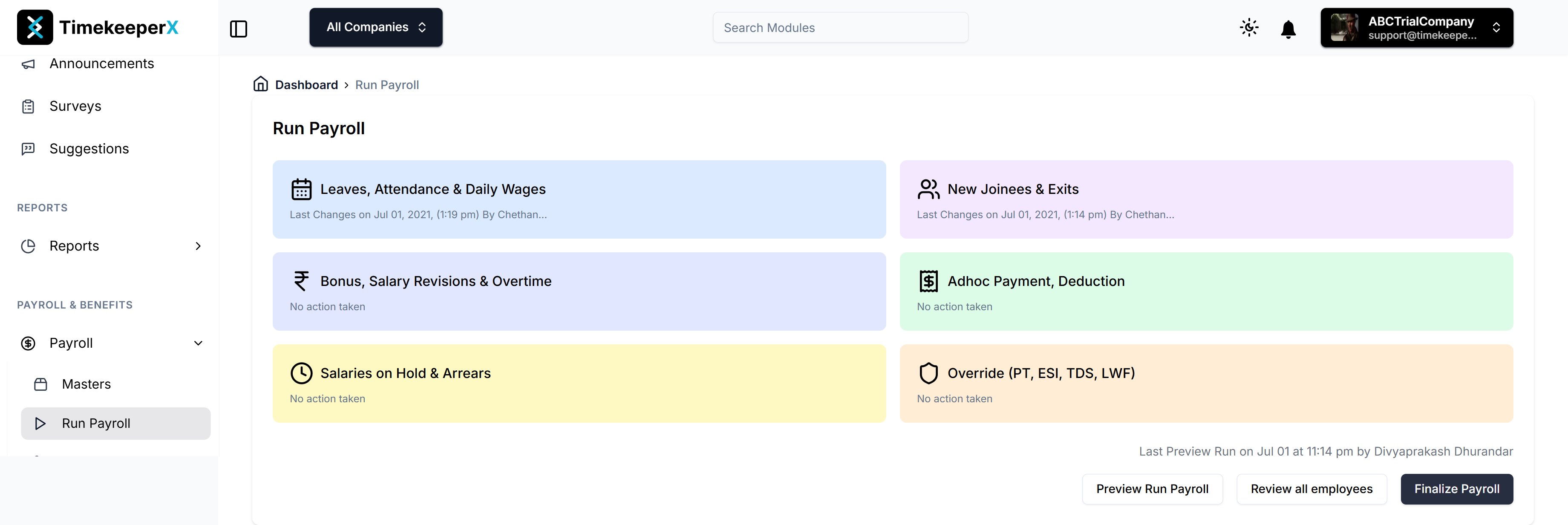
The Core Logic
At the heart of TimeKeeperX is a highly optimized salary engine. Initially, the engineering team utilized an iterative algorithm to force the circular dependencies (like Provident Fund and Employee State Insurance) to slowly converge on a precise solution . However, to achieve precision at scale, the team transitioned to a streamlined algebraic method
Base Pay Calculation
The algorithm instantly establishes the core fixed components directly from the CTC (C). Basic Salary (B) is defined as 50% of the CTC, while House Rent Allowance (HRA) is mapped to 25% of the CTC
Resolving Statutory Circularity
Rather than calculating in loops because PF and ESI depend on Gross Salary (and vice versa), the system uses pre-calculated algebraic formulas . For example, if PF wages are below 15,000 and ESI applies, the Gross Salary (G) is calculated instantly using the formula G ≈ 0.89394 × C . Other Allowances (OA) are then cleanly derived by subtracting Basic and HRA from the Gross.
Prorated Deductions for Unpaid Leaves
Once the base algebraic salary structure is defined, the algorithm calculates the per-day wage. Unpaid leaves trigger a precise, prorated deduction from the gross fixed pay, dynamically adjusting the taxable income bracket without breaking the foundational CTC math.
Overtime Multipliers
For non-exempt employees, overtime hours logged in the time-tracking module are multiplied by statutory or company-specific rates (e.g., 1.5x or 2.0x standard hourly wage) and added dynamically as a separate pre-tax earning component.
Edge Case Handling
Payroll logic is only as strong as its ability to handle edge cases. TimeKeeperX manages complex scenarios seamlessly:
Statutory Thresholds & Negative Allowances
The algorithm mathematically accounts for strict caps, such as PF wages being capped at ₹15,000, and branching logic for when ESI does not apply (Gross > ₹21,000) . Furthermore, it actively monitors for edge cases where "Other Allowances" might calculate as a negative number, dynamically adjusting Basic and HRA components to prevent mathematical errors .
Mid-Month Joiners & Variable Shifts
For employees joining mid-cycle, the system calculates a prorated "Effective CTC" based on calendar days worked before feeding it into the algebraic engine. Variable shifts and public holidays rely on an integrated attendance mapping system that validates shift premiums and holiday pay multipliers before finalizing the gross payout.